Healthcare is one of the most stable, in-demand, and rewarding career paths in Kenya and globally. The Certified Nursing Assistant (CNA) course at MTTI Eldoret gives you a government-accredited healthcare qualification in just 6 months — and opens doors to employment at hospitals, clinics, nursing homes, and even career opportunities abroad in Germany, the UK, and the Gulf region.
If you are looking for a meaningful career that combines job security, good pay, and the satisfaction of helping people — this guide tells you everything you need to know about MTTI’s CNA program in Eldoret.
What Is a Certified Nursing Assistant (CNA)?
A Certified Nursing Assistant — also called a Nursing Assistant, Nurse Aide, Patient Attendant, or Healthcare Support Assistant — is a trained healthcare professional who provides direct patient care under the supervision of registered nurses and doctors.
CNAs are the frontline of patient care. They are the people who spend the most time with patients, providing hands-on support and ensuring dignity, comfort, and safety throughout recovery. Their work includes:
- Monitoring and recording patient vital signs (blood pressure, temperature, pulse, respiration)
- Assisting patients with personal hygiene — bathing, grooming, dressing, toileting
- Supporting patient mobility — helping them walk, turn, transfer between bed and wheelchair
- Providing dietary support — meal preparation, feeding assistance, monitoring nutrition intake
- Wound care, bed sore prevention, and skin integrity monitoring
- Infection control and maintaining a sterile, safe patient environment
- Providing emotional support and companionship, especially for elderly and palliative patients
- Assisting with medication reminders and administration as directed by nurses
- Documenting patient observations and reporting changes to the nursing team
- Basic first aid and emergency response
In short, CNAs are essential to every hospital, clinic, nursing home, and home care setting. Without them, the entire healthcare system slows down.
Why CNA Is One of the Most Marketable Courses in Kenya Right Now
Kenya’s healthcare sector is growing rapidly. Here is why CNA graduates are in high demand right now:
1. Kenya’s Ageing Population Needs Care
Kenya’s population above 60 years is growing faster than ever. Elderly care — both in facilities and at home — is one of the fastest growing segments of the healthcare industry. Trained CNAs are the professionals families and institutions call first.
2. County Hospitals Are Expanding
With the devolution of healthcare to county governments, facilities like Moi Teaching and Referral Hospital, Uasin Gishu County Referral Hospital, and smaller sub-county hospitals are all expanding their support staff. TVETA-certified CNAs qualify for these positions directly.
3. International Demand Is at an All-Time High
The UK, Germany, USA, Canada, Australia, and Gulf countries are all experiencing severe healthcare worker shortages. Kenyan CNAs with proper certification are actively being recruited for caregiving positions abroad, many earning the equivalent of KES 200,000–400,000 per month. MTTI’s CNA program specifically prepares students for the German Ausbildung pathway — a formal apprenticeship program that allows you to work and earn in Germany while completing further training.
4. Private Clinics and Nursing Homes Are Booming
Private healthcare facilities have multiplied across Kenya. Every new clinic, nursing home, dialysis centre, and rehabilitation facility needs CNAs. Most prefer candidates with TVETA-accredited certificates.
“I completed the CNA course at MTTI in 6 months. I am now working at a private clinic in Eldoret earning KES 25,000 per month. Healthcare is a career that never lacks jobs. Join CNA today!”
— Nurse Mercy Chebet, MTTI CNA Graduate, 2025
What You Learn at MTTI: The CNA Curriculum
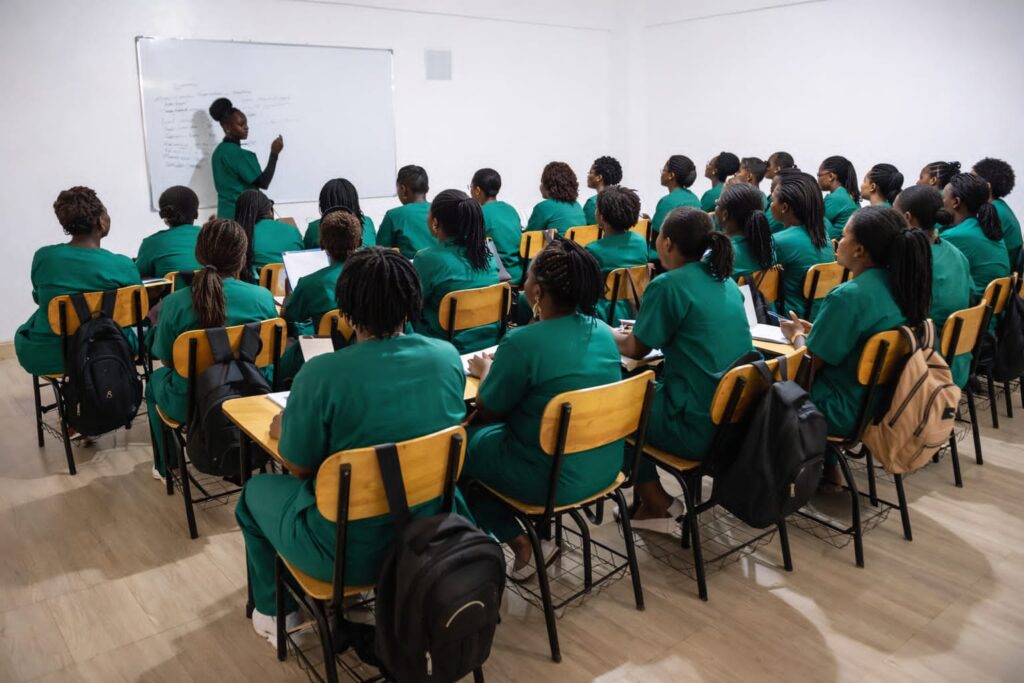
MTTI’s 6-month CNA program is fully accredited by TVETA (Technical and Vocational Education and Training Authority). The curriculum covers both theory and extensive practical training, ensuring you graduate work-ready — not just certificate-ready.
Unit 1: Foundations of Healthcare
You begin with the context of healthcare in Kenya — how the system is structured, the role of CNAs within the nursing team, professional ethics, patient rights, legal responsibilities, and healthcare documentation. This unit establishes the professional mindset every healthcare worker needs.
Unit 2: Human Anatomy & Basic Medical Terminology
Understanding how the body works is essential to providing good care. You learn the major body systems (cardiovascular, respiratory, musculoskeletal, digestive, neurological), common medical terms, and how disease and injury affect different systems. This knowledge helps you communicate effectively with nurses and doctors.
Unit 3: Patient Care & Activities of Daily Living (ADLs)
This is the core hands-on unit. You practice and master the techniques for:
- Safe patient handling — how to lift, move, and transfer patients without causing injury to them or yourself
- Bathing, oral hygiene, grooming, and dressing assistance
- Bed making with and without a patient in bed
- Catheter care, colostomy care, and urinary and bowel management
- Pressure ulcer (bed sore) prevention and wound care basics
- Feeding patients with swallowing difficulties
Unit 4: Vital Signs & Clinical Observation
You learn to measure, record, and interpret: blood pressure, temperature, pulse rate, respiratory rate, oxygen saturation (SpO2), blood glucose, and pain levels. You also learn which abnormal readings require immediate escalation to the nursing team and how to document accurately.
Unit 5: Infection Control & Patient Safety
Healthcare-acquired infections are a major global challenge. You learn hand hygiene protocols, the correct use of Personal Protective Equipment (PPE), isolation procedures, waste disposal, sterilisation techniques, and how to maintain a safe, clean patient environment. This unit became even more critical post-COVID-19.
Unit 6: Nutrition & Dietary Support
You learn the basics of clinical nutrition — how different conditions (diabetes, kidney disease, hypertension, malnutrition) require specific dietary approaches. You practice preparing therapeutic diets, calculating caloric needs, and assisting patients with feeding and hydration.
Unit 7: Mental Health & Dementia Care
Working with elderly patients, those with dementia, or patients with mental health challenges requires specific skills. This unit covers communication techniques for cognitively impaired patients, managing challenging behaviours, preventing patient falls, and providing compassionate end-of-life care.
Unit 8: First Aid & Emergency Response
You learn to respond to emergencies before the doctor arrives — CPR (cardiopulmonary resuscitation), choking response, management of falls, bleeding control, burns, and shock. This training could save a life and is a requirement for any healthcare position.
Unit 9: Housekeeping & Environmental Services
Clean healthcare environments prevent infections. You learn hospital housekeeping protocols — proper cleaning and disinfection of patient rooms, operating theatres, bathrooms, and common areas, as well as correct medical waste segregation and disposal.
Unit 10: Clinical Attachment (Practical)
Theory without practice is incomplete. During the course you complete supervised practical sessions in a clinical setting, where you apply everything you have learned on real patients. You graduate with both classroom knowledge and genuine hands-on experience.
Who Can Enroll? Entry Requirements
MTTI’s CNA course is one of the most accessible healthcare programs in Kenya. Entry requirements are:
- Minimum education: KCSE certificate (any grade — D plain and above preferred for TVET CDACC licensure pathway)
- Age: 18 years and above
- Medical fitness: Good general health (no communicable diseases)
- Language: Basic English comprehension
- Prior experience: Not required — complete beginners welcome
If you have a D- or below, you can still enroll and complete the caregiver level qualification. Our admissions team will advise you on the right exam pathway based on your KCSE results.
CNA Course Details at MTTI Eldoret
- Duration: 6 Months (including clinical attachment)
- Fee: KES 59,000 (installment payments accepted)
- Certification: TVETA-accredited Certificate in Healthcare Support Services
- Exam body: TVET CDACC (government examination body)
- Sessions: Morning and afternoon classes, Monday–Saturday
- Location: Sagaas Centre, 4th Floor, Eldoret
- Intake: Rolling — new cohorts start regularly (limited slots per intake)
- Uniform: Included in program
How MTTI Compares to Other CNA Colleges in Kenya
| Factor | MTTI Eldoret | Nairobi Colleges | Some Private Colleges |
|---|---|---|---|
| Location | Eldoret (local, no relocation) | Nairobi (travel + rent costs) | Nairobi/Mombasa |
| Fee | KES 59,000 | KES 50,000–90,000 | KES 90,000–200,000 |
| TVETA Accreditation | Yes ✓ | Varies | Varies |
| Duration | 6 months | 3–12 months | 4–18 months |
| Installment payment | Yes ✓ | Varies | Usually No |
| German Ausbildung pathway | Yes ✓ | Rare | Some |
| Class sizes | Small — personal attention | Often large | Varies |
What Can You Do After Completing the CNA Course?
Work in Kenya
With your TVETA certificate you are qualified to apply for positions at:
- County and sub-county government hospitals (Moi Teaching and Referral, Uasin Gishu County Referral, AIC Litein, etc.)
- Private hospitals and clinics across Kenya
- Nursing homes and elder care facilities
- Rehabilitation centres and disability support organisations
- Private home care for elderly or chronically ill patients
- Schools and educational institutions as health support staff
Entry-level CNA salaries in Kenya range from KES 15,000–35,000 per month at smaller facilities, and KES 25,000–50,000 at larger hospitals and private facilities, depending on experience and location.
Work Abroad — The International Opportunity
This is where the CNA qualification becomes life-changing. The global shortage of healthcare workers means Kenyan-trained CNAs are actively recruited internationally:
- Germany (Ausbildung Pathway): MTTI specifically prepares students for the German nursing pathway. You complete further training in Germany while being paid a monthly stipend. After qualification, salaries reach EUR 2,500–3,500/month (approximately KES 350,000–500,000). MTTI’s German Language course (offered alongside CNA) accelerates this path significantly.
- United Kingdom: The NHS actively recruits Kenyan healthcare workers. Entry-level healthcare assistant positions pay £20,000–£26,000 per year.
- Gulf Region (UAE, Saudi Arabia, Qatar): Tax-free salaries of USD 800–1,500/month are common for CNAs.
- Canada & Australia: Long-term immigration pathways exist for qualified healthcare workers.
“After CNA training at MTTI, I got employment at Moi Teaching and Referral Hospital. The TVETA certificate opened doors I never imagined.”
— Samuel Rotich, MTTI CNA Graduate, 2025, Nandi County
Frequently Asked Questions About the CNA Course at MTTI
Is the MTTI CNA certificate recognised by employers?
Yes. MTTI is accredited by TVETA — Kenya’s government body for technical and vocational education. Our CNA certificate is recognised by hospitals, clinics, and healthcare facilities across Kenya. It also qualifies you for the TVET CDACC national examination for a Healthcare Support Services license.
Do I need to know nursing before enrolling?
No prior healthcare knowledge is required. Many of our students come directly from high school or from completely unrelated backgrounds. Our instructors take you from the very beginning.
Can I do the CNA course while working?
We offer morning and afternoon sessions. If you currently work, speak to our admissions team about scheduling — we try to accommodate working students wherever possible.
Can men enroll in the CNA course?
Absolutely. Male CNAs are in particularly high demand for working with male patients in hospitals, rehabilitation centres, and for home care of elderly men. Both men and women are welcome.
What happens if I fail the TVET CDACC exam?
MTTI prepares you thoroughly for the government exam. However, if you need to resit, TVET CDACC allows multiple attempts. Our instructors continue to support students through the exam process even after the course ends.
Is the KES 59,000 all-inclusive?
Please confirm exact inclusions with our admissions office at enrollment — fees cover tuition and core course materials. Speak to us directly about what is included and available payment plans. We work hard to make the course accessible.
Limited Slots — Next Intake Open Now
MTTI deliberately keeps CNA class sizes small to ensure every student gets proper personal attention during practical training. This means intake slots fill up quickly. If you are considering the CNA course, now is the time to secure your place.
📞 0712 464 936
📧 info@masomoteletraining.co.ke
📍 Sagaas Centre, 4th Floor, Eldoret
🕐 Mon–Sat, 8am–6pm
You can walk in during working hours or send us a WhatsApp message and we will respond within minutes with full details on the next intake date, payment plan options, and what to bring on your first day.
🏥 Enroll in MTTI’s CNA Course — Next Intake Open
6 months. TVETA-accredited. KES 59,000 with flexible installments. Limited slots per cohort — secure yours today.